


About the Washing station
Coporoca Washing Station is located in the Nyamasheke District of Rwanda, where coffees flourish in volcanic soils and a cool, rain nourished climate. It serves over six hundred smallholder farmers, each cultivating between 400 and 500 coffee trees. Coffee is harvested annually from February to June, followed by meticulous processing from March to June. The washing station is committed to sustainable farming and coffee production, while actively working to uplift the community of farmers.
History
The journey of Coproca Coffee Washing Station is a testament to the transformative power of community-focused development. Over the years, the station has introduced microcredit services, formed 20 farmers' groups. Additionally, it created over 150 jobs, distributed free coffee seedlings and shade trees, and improved local infrastructure by building bridges and roads. These efforts have driven economic growth, increased school enrollment, and bolstered community well-being, turning the station into a hub of sustainability and opportunity.
 |
 |
 |
Sorting
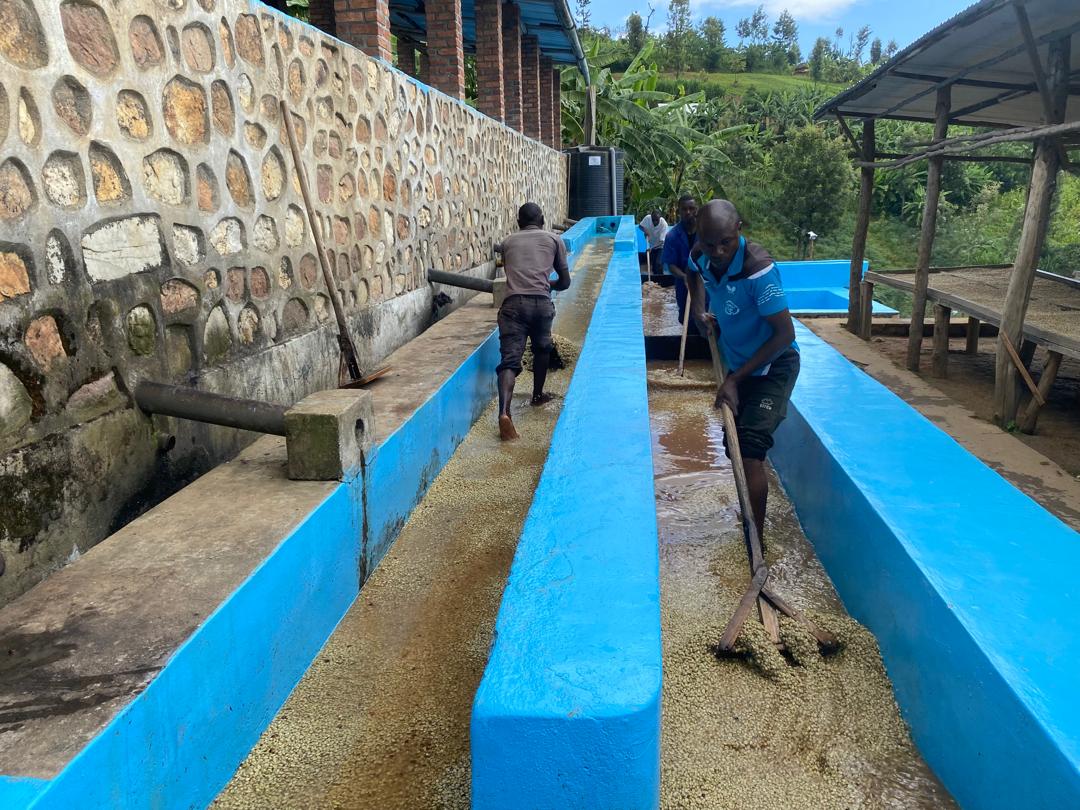
The coffee undergoes multiple stages of sorting to ensure only the finest beans are selected. Initially, farmers sort out defective cherries at home before their harvest is weighed. At the washing station, a quality controller conducts another round of inspection to identify defects. The cherries are then placed in a tank, where defective or bug damaged cherries float to the surface. Next, the coffee moves through water channels that separate heavier beans from lighter ones during the Within 8 hours of harvest, the cherries are pulped using a Mackinon disc pulper with three discs. The parchment then undergoes dry fermentation for 12-18 hours, followed by a thorough wash to remove any remaining mucilage. After an 18-20 hour soaking process, the beans are dried on 60 raised beds for consistent and even drying. Environmental care is integral to this process. Wastewater is isolated in soaking pits, where it is treated using Effective Micro-organism (EM) technology to minimize environmental impact, ensuring a sustainable and eco-friendly approach to coffee production.
The Process
Within 8 hours of harvest, the cherries are pulped using a Mackinon disc pulper with three discs. The parchment then undergoes dry fermentation for 12-18 hours, followed by a thorough wash to remove any remaining mucilage. After an 18-20 hour soaking process, the beans are dried on 60 raised beds for consistent and even drying. Environmental care is integral to this process. Wastewater is isolated in soaking pits, where it is treated using Effective Micro-organism (EM) technology to minimize environmental impact, ensuring a sustainable and eco-friendly approach to coffee production